
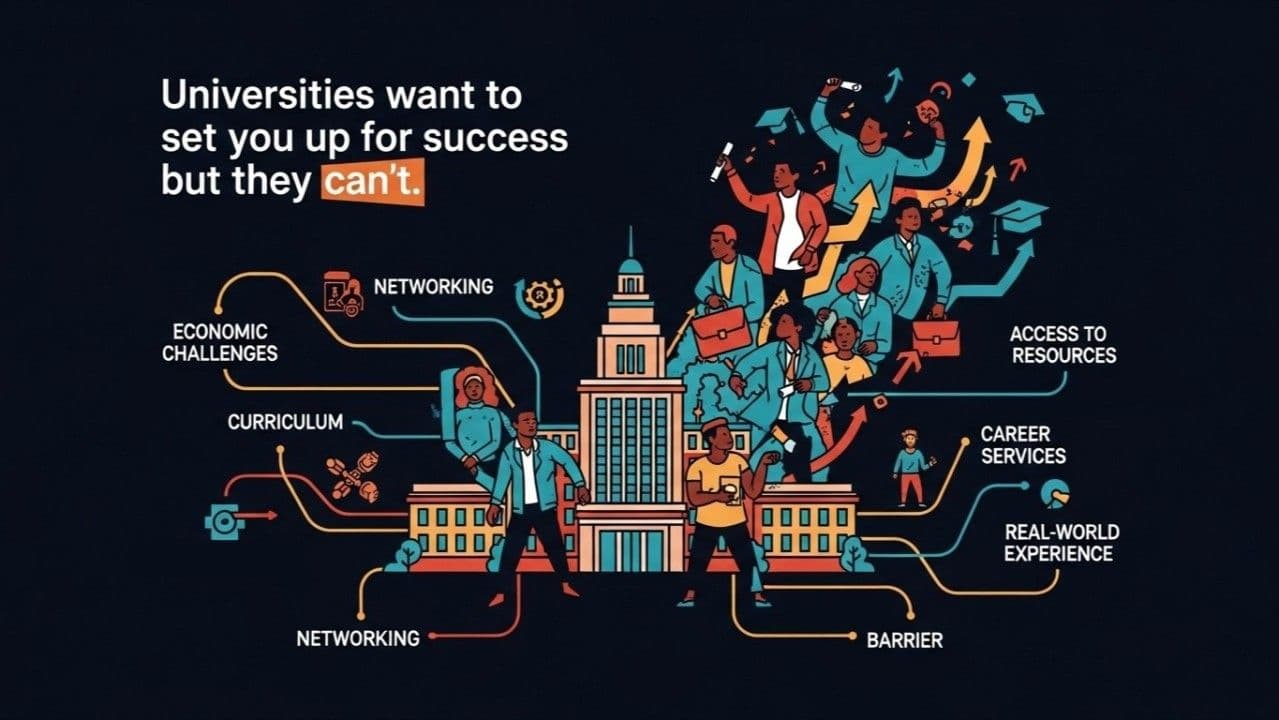
Universities want to set you up for success but they can’t
But you have the chance to shape your own destiny
Your name is called. Cameras flash. Your parents are beaming as the Chancellor shakes your hand.
4 years of late-night study, high-stakes exams, and maybe a few too many instant noodles are behind you. You’ve done it.
You step out into the world expecting a clear path to a meaningful career. After all, you’ve paid your dues, earned the degree, and now it’s time for the return on investment. Breathtaking, isn’t it?
This was our reality. For most of us, graduation felt like the beginning of a dream, until we realised no one told us how to wake up.
Across much of Africa, the reality hits hard right after graduating. Graduates in Ghana and Nigeria may be lucky to be enrolled in one year of mandatory national service, which is often a lifeline — the final shot at building experience.
Yet, year after year, about 90% of graduates in Ghana are not retained. For that 90%, the search for a permanent job can stretch out for years ; sometimes up to a decade.
Now, think about what that really means.
If a graduate from Africa could be earning say $12,000 per year, 5 years spent unemployed costs roughly $60,000 in lost income, and in Ghana, that figure could double. This is money that could have been used to launch your own venture or support your family. Beyond the money, it’s the lost time, the lost confidence, the lost sense of purpose.
But here’s the hard truth: it’s not because universities don’t want you to succeed. It’s because they can’t.
In this article, I will share my perspectives on the root cause of this inability and what the future looks like.
A system not built for your future
At Ghana’s premier university, for instance, only 4 career counsellors are serving over 60,000 students, including graduate students. That’s 1 counsellor for every 15,000 students.

If every student somehow booked time with the career office, each would get just seven minutes of contact time a year — less than it takes to finish a morning bath. This isn’t enough time to even begin a proper Career Discovery exercise, which typically takes a minimum of 2 hours.
7 minutes to talk about your career, your goals, your fears, your future. And that’s if you even know the office exists. Reminds me of a poll I ran sometime ago on LinkedIn. The results were very fascinating.

The system isn’t designed for personalized support. Career counselling isn’t part of the curriculum. It’s not graded. Soft skills training isn’t prioritized. Nobody goes through education for intellectual orgasm. In the end, it is a pathway to income. On the contrary, career development is treated like an optional seminar and not the central purpose of undergraduate education.
So you spend four years learning how to pass exams, but not how to navigate the world after them. I can imagine what happens in several other public universities where the masses study.
The illusion of readiness
Most students fall for a comforting illusion: “Once I finish my degree, the jobs will find me.” To be honest, some lecturers also fuel this illusion with “Pass your exams so you can get jobs later”. But the job market doesn’t work like that.
During university, you’re actually in the best position to get opportunities. Recruiters are far more likely to give students a chance as interns than to hire fresh graduates with no experience. Yet most students only start thinking about work after school, when their “student pass” has already expired.
By then, the empathy of the job market wears off.
Universities emphasize academic intelligence, but not necessarily curiosity or agency — the willingness to take initiative, to ask questions, to build something on your own. Intelligence gets you in the room; curiosity and agency keeps you there.
Education should make you curious enough to explore beyond lecture notes. To research, to build, to fail, to try again. That’s how thinkers become doers.
Your future is too important to outsource
This isn’t a critique of the dedicated lecturers or the overworked career staff. It is a necessary wake-up call to everyone in the higher education ecosystem — students, parents, and funders alike.
The university system is doing what it has always done, but the demands of the modern job market have changed radically. The traditional model is broken, and it cannot be fixed with a few extra workshops or annual job fairs.

Today, effectively guiding 100,000 students would require 100,000 mentors. This lacks efficiency and inherently limits access. In this age of information, however, the only way to deliver scalable, personalized and career-focused education is to combine technology with a fundamental shift in responsibility.
We must move the power of career development out of the overwhelmed office and put it squarely into the hands of the student. Your career success cannot be a 7-minute annual appointment. It needs to be an everyday habit layered with technology to help with visibility on your growth journey.
Job search is just a fragment of career guidance. Elements such as career discovery, self-awareness, skills building including soft skills and entrepreneurship, high-quality mentorship on demand, among others, are a fundamental part of the process. Leveraging modern technologies can drive access for everyone at a low cost without compromising on quality. “I did not know” or "we are overburdened" should no longer be an excuse for not accessing career guidance in the university.
Time to take control
Sadly, most students are not aware of this reality. Parents neither. By 2050, 1 in 4 young people globally will be African, but these stats are meaningless and only stuck in potential if we are going to leave the development of the current generation to chance.
The good news is, you don’t have to wait for the system to change. Young people can take the wheel today.

The first step to solving a problem is understanding its size because you can’t fix what you don’t see. On November 5, the team at Mande is launching a free career readiness diagnostic tool to help students see their current reality.
By answering a series of simple, insightful questions, we project how long it might take you transition into the workforce. This isn’t meant to scare you, but rather, it’s meant to arm you with the awareness you need to start building the skills that employers are willing to pay for as well as those that set you up for success as an entrepreneur.
There is more to come.
To wrap it up…
If we want to change Africa’s narrative, we all have a role to play. Students must take initiative. Universities must rethink what “career readiness” means. Funders must invest in scalable, measurable models of employability.
No single institution can fix this alone — but together, we can give every young African a fair shot at success.
About the author
Joel Kojo Abaka Anaman is a 5x career transitioner who's lived on all sides of the talent ecosystem —as a recruiter, founder/hiring manager, job seeker, and career coach. He has helped African professionals build global careers at Career Wheel, unlocking over $2.5M in annual recurring income.
By day, Joel leads teams at Axmed as a Senior Product Manager, building pharmaceutical procurement solutions that drive access to medicines. Outside Axmed, he leads product at Mande, an autonomous AI career companion for African undergraduates. With students having access to only 7 minutes of career guidance per year, Joel is on a mission to empower 1 million young Africans by 2030 with clear career pathways and accessible, high-quality guidance powered by AI.